Full Auto: Tool or Toy?
Part II. Training and Equipment
Last week we had a pretty in-depth discussion about the different varieties of full auto weapon systems and their potential usage for civilians in more serious use-cases. Check it out HERE. To summarize, I concluded that in the most likely civilian use case, the sub-machinegun is the winner. This is not to say that sub-machineguns are the most civilian-applicable weapon on the market (I don’t really believe in a "best," I like all of them!), but that if the subject is full auto weapons, or systems that benefit from FRTs, the sub-gun/PDW class stands to benefit the most.
Consider:
- Full auto assault rifles (see the first article for the true definition of an “assault rifle”) don’t really add much value over semi-auto carbines.
- Real machineguns i.e. belt fed weapons with quick-change barrels meant for sustained fire, are key weapon systems of the infantry platoon or squad, and I believe protected by the 2nd Amendment, BUT questionable in value when it comes to the most likely threats of today’s world.
Sub-machine guns and PDWs (so called “personal defense weapons”) are best employed at CQB distances and/or confined settings such as fighting from a vehicle or inside a structure, and where fitting the weapon in small spaces (like a vehicle or backpack) prior to deployment may be necessary. This pretty much describes defense against armed terrorist attacks, active killers, home invaders, or lethal mob violence. In my opinion while miniaturized PCCs (pistol caliber carbines) are OK, I'd much rather have a real sub-machinegun!
Reliability
Back in the “civilian” world of FRTs we run into an equipment issue: namely, the aftermarket. Like every other aftermarket part in the world, the part may or may not have been effectively R&D'd on the platform you are installing it in. Full auto fire is extremely demanding on guns and gun parts, to the point that the US Army’s M4 carbine had to be redesigned because US SOCOM personnel were destroying it by using it for standardized full-auto drills in the course of normal training. High round counts with an FRT will be highly demanding on the operating system (bolt, bolt carrier, barrel, gas key etc.), never mind the complication of the FRT itself. Most civilian AR-15s, honestly most guns designed for the civilian market period, especially at the lower price points, are simply not designed for this abuse. Just because someone makes an FRT that can be installed does not infer that the design is adequately robust for the firearm to used with that function in a serious environment for a significant round count.
This is a good time to pause and think about equipment reliability and the fact that if your gun doesn’t go bang because some aftermarket part didn’t work, you might die. So choose wisely and train accordingly.
In general, I consider platforms that were originally designed and R&D’d as full-auto platforms, then reduced in capability to sell on the civilian market, safe bets for FRT usage. This, of course, is not considering the FRT itself, which could be a piece of junk no matter what you install it in! I consider everything else to be untested until proven otherwise. On that topic: please refer to sentence in bold typeface above! Two positive examples would be the HK MP-5 and FN P90. Both were originally designed as full auto platforms for government customers, and have pretty good track records as such. I would consider either of these to be in the “go” category. Personally, I take reliability very seriously, so anything that was not specifically designed for full auto application goes in the “untested” category, and I don’t bet my life on things that are untested. Bottom line: if you want something for fun, knock yourself out, but if you consider this gun to be for serious defensive use, and as such you will undertake equally serious training, the recommendation would be for a platform that has a military service record in a select-fire configuration.
Training Issue #1: Use of Burst Fire
Just discussing the usage of fully automatic weapons systems by civilians invites howls of rage from the enemies of the 2nd Amendment (perhaps we should just refer to them as enemies of the constitution) which gives me a certain amount of glee. However, even some staunch believers in the 2nd Amendment also grow uncomfortable when we start talking about full-auto, largely, I think, for the following reasons: training and competence. There’s a point to be considered here. Firearms in general are a liability instead of an asset without proper training, and without morally and ethically straight humans to wield them, which is a whole other subject. This becomes exponentially more true with full auto, or auto-like, capabilities. In today’s world every bullet has a lawyer behind it, and the fact is that all full auto weapons systems become area suppression weapons beyond a certain range.
Let’s think of it this way: burst-fire from a full-auto system is more like a shotgun pattern and less like a rifle shot. In the world of machinegun employment that “pattern” is called a “cone of fire.” That said there is a major difference. A shotgun pattern depends on the ammunition, choke, and barrel, but not on the shooter. Conversely, a cone of fire does depend on the shooter. Equipment is certainly an element though. For instance some sub-machineguns, (the MAC-10 comes to mind) are notorious for spraying the entire landscape with lead regardless of shooter skill. Similarly, there’s only so much accuracy you can expect from open-bolt belt-fed systems. They’re really area weapons. That being said, a lot depends on the shooter. There are right ways and wrong ways to handle weapons in rapid fire, and they often vary depending on exact equipment and usage.
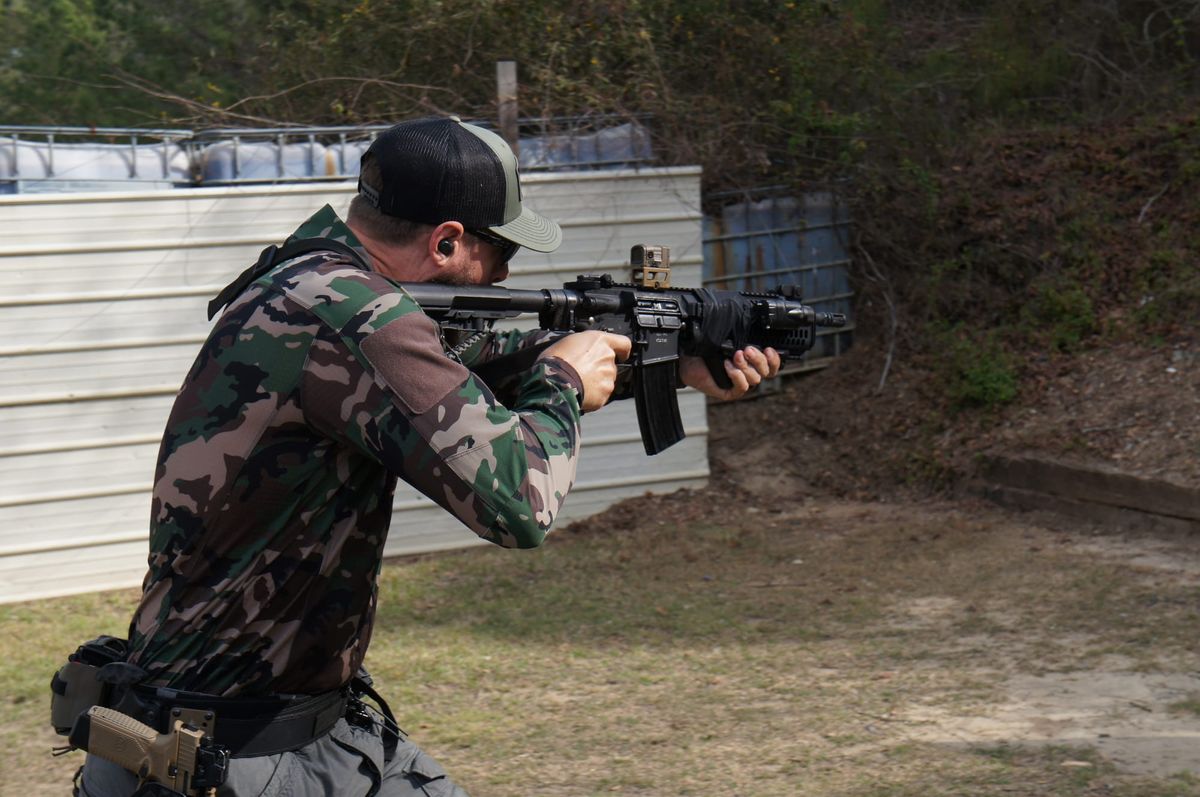
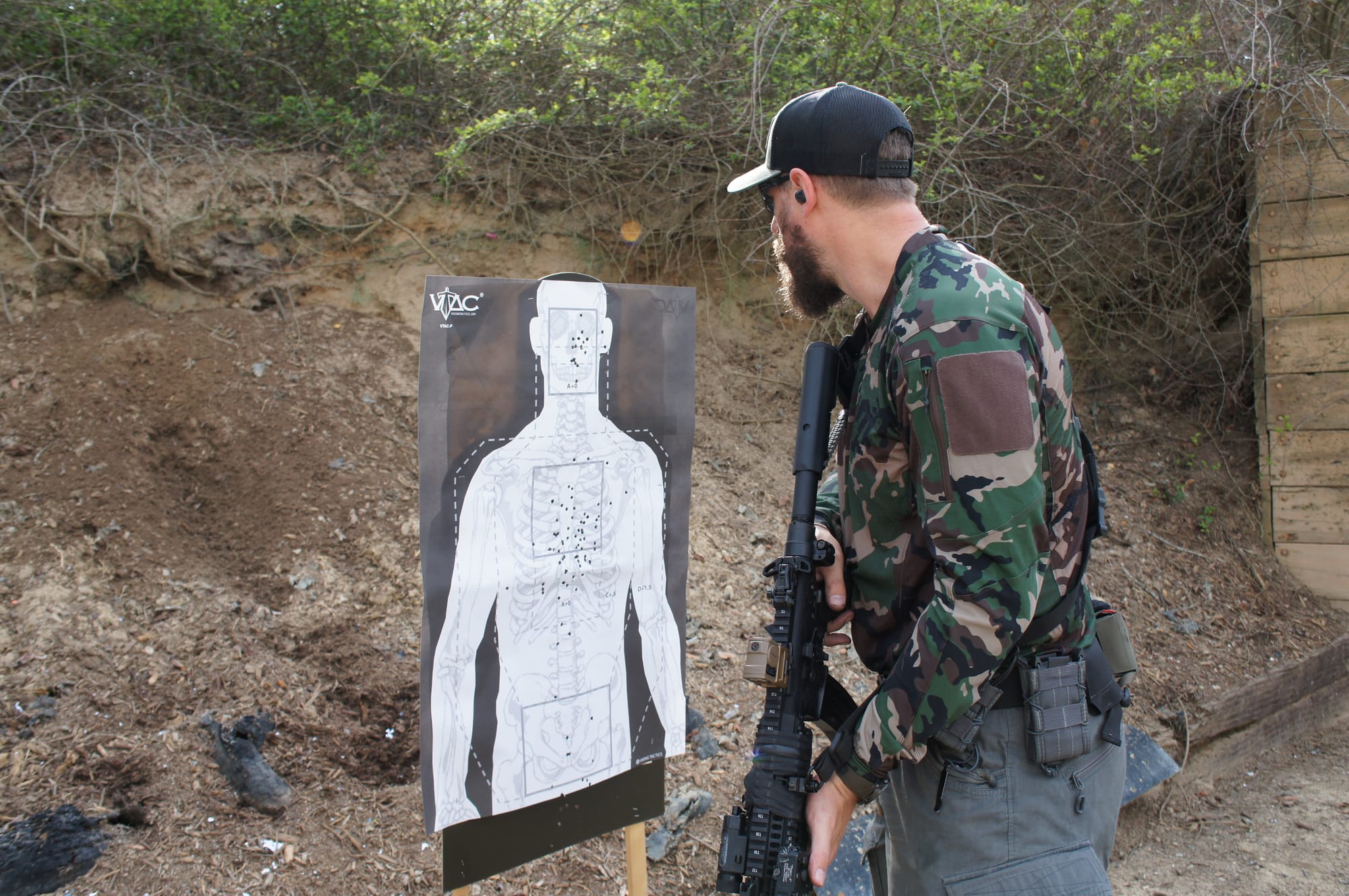
Lets consider an example. My 11.5 inch Colt IAR can easily keep bursts in a torso, mostly in an A-zone (with correct technique) out to around 25 yards. Figuring out how to wring maximum performance from this thing took some experimentation though. I found that the best recoil control with this gun is accomplished by using very hard pressure with my firing hand and just guiding with my non-firing hand. I tried using heavy sling tension, various hand pressures, and various other techniques. Some techniques that I thought might work, absolutely don’t. For instance, I know accomplished shooters who swear by using heavy sling tension for recoil control, but for this system, at least for me, this causes unacceptable lateral dispersion. I never would have realized any of this until I actually put rounds through the gun and experimented.
Similarly, at 300 yards this gun performs well as a rifle. Used with the typical 8-12 or 3-5 round bursts, with a bipod and correct body mechanics, multiple hits per-burst on steel silhouettes are very achievable, making it effective in the light machinegun role as well. However, full auto with no bi-pod drastically reduces effective range to the point where at 300 yards I’m getting 1, or maybe 0, hits on target.
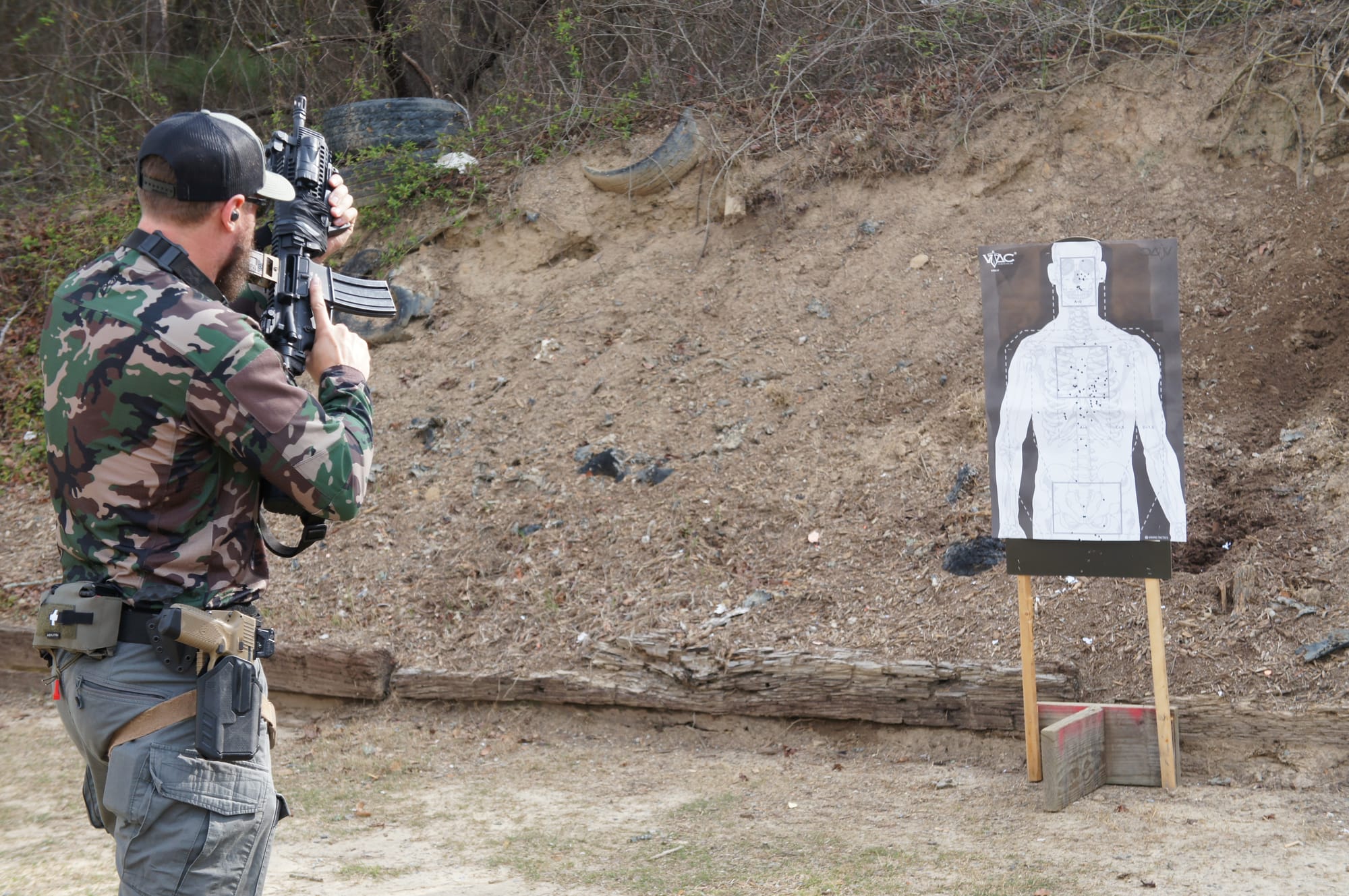
Burst fire drill with an 11.5 Colt Infantry Automatic Rifle setup at 10 yards. I don't think I could do this with an M4A1. Specific equipment makes a huge difference!
Bottom Line
In order to employ full auto, or auto-like, systems effectively you must:
- Have the baseline of training to know how to use the system in the first place
- Take enough time and ammo to get to know that particular system, since all guns are not equal!
Training Issue #2: Use of Selector Switches
Finally, lets take a look at another noted Achilles’ heel of some select fire weapons: selector manipulation under stress. Former USMC Officer and noted HK weapons trainer James Williams believes that the best way to run an MP-5 is with the safety off, using the trigger finger’s position outside the trigger guard as the primary safety mechanism, similar to the way we would run most modern striker-fired pistols. Once you get behind an MP-5, especially if operated on full auto, the reasoning behind this becomes abundantly clear. The selector switch on an MP-5 is quite difficult to manipulate in the time frames expected of life-threatening close quarters engagements, especially when the shooter is going from safe all the way to full auto. Furthermore, if you are accustomed to the AR platform it is very easy to switch an MP-5 from “auto” to “semi”, thinking you just rotated the selector from “auto” to “safe.” This is an obvious recipe for disaster. In fact, some noted firearms trainers with extensive military backgrounds do not recommend utilizing full auto in CQB just because of the selector manipulation issues, specifically those inherent to the AR and MP-5 platforms. While I don't personally adhere to this point of view, I think it bears repeating as a point to ponder.
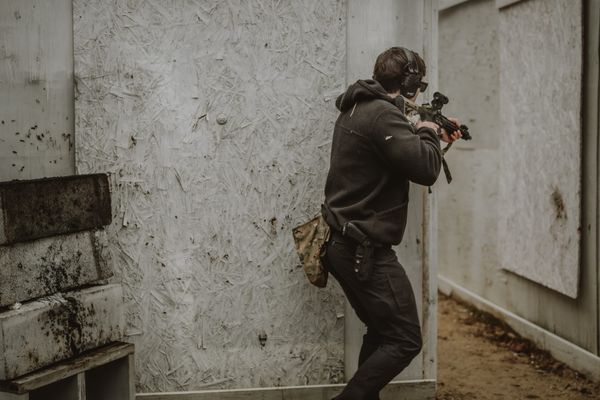
While the purpose of this article is not to debate safety manipulation in CQB (a pretty contentious topic) I think we should all agree on one thing: you should never let a functioning, non-safed weapon, hang on a sling. I say “functioning” because if you are doing an emergency transition to a pistol due to a malfunction, or because you ran dry, that is different. At no time, however, should you attempt a transition (with a functioning weapon) prior to being 100% sure that the weapon is on safe. Because of the natural positions of selector switches, specifically on the AR-15 and the MP-5, running these guns on full auto in a high stress CQB environment can be right down dangerous if correct selector switch discipline during transitions from primary to secondary weapons, or from primary weapons to manual tasks, like opening a door or treating a casualty, is not drilled to the point of being subconscious.
Wrap-Up
I have two practical conclusions about FRTs, and about full-auto, for serious defensive use:
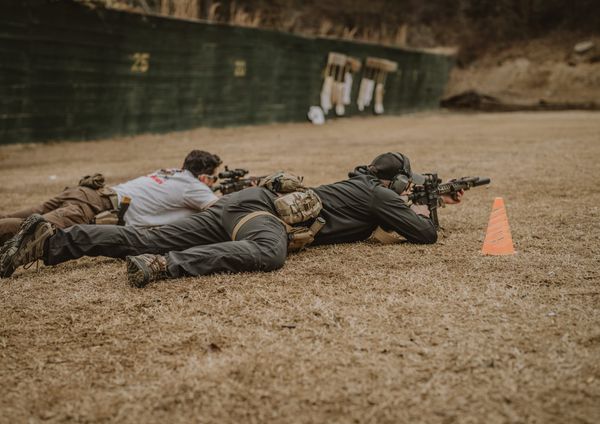
- Training is a must. Period. I would go so far as saying that if you are not willing to put 500 rounds through the gun in the first couple months of ownership, just to get a handle on what you are dealing with and how it really runs, you probably shouldn’t be bothering with this. If the task of working with a specific gun until using it safely becomes subconscious seems onerous to you, defensive use of full-auto and FRTs might also not be for you.
- Quality equipment is key. The US firearms market is a huge place, and firearms quality variance in that market is equally huge. Full-auto, or auto-like, fire is extremely demanding on weapons. If it wasn’t designed for that you might not want to use it for that.
We hope you find these articles to be thought-provoking. Be armed, be trained, and I’ll see you on the range!