Trauma Medical Training for Civilians: Underrated Training, Outsized Results
You hear the automatic gunfire first, then the screaming. This is the real thing, and you're on the X. Time slows down. Later, if you live to remember, you’ll realize that this all happened in less than five seconds, but right now you wouldn’t think the second hand had stopped, you’d think the entire calendar had stopped. You look in the direction of the gunfire, about three yards down the hallway, around a corner. As your left hand grabs your shirt to pull it up and out of the way of your pistol grip, your right hand descends towards the gun. A terrified woman careens around the corner. You see the terrified set of her face, the way her hands are thrown out for balance as her shoes slide on the tile floor. Your brain registers a sort of “fssst” and you reflect that that must be the sound of a bullet passing the corner in front of you, just in front of your face. Your right hand finally closes around your CCW piece. "Good grip," your brain says, thumb over the top to keep the shirt out of the way, the gun comes free. Then there he is. A man, masked in black, a pistol extended, jogs around the corner. Your muzzle clears the holster and your arm begins to rotate the muzzle towards him. Your brain begs your hands, which feel like molasses right now, to move faster. You see his muzzle flash first, then you hear the R-I-I-I-I-P of full-auto fire. Something hits you in the lower body and you lose your balance. Your brain says, “He must have a switch,” as you watch his muzzle track off of you and spray bullets past you down the hall in a long burst. Your hands finally manage to get your muzzle onto him, you don’t even see your own dot, but your slide is pretty level and your brain is screaming “TRIGGER NOW” inside your skull. Your trigger finger pulls back and you, seemingly involuntarily, rip several shots into his chest. Even later you can’t quite remember how many. He stumbles back and his muzzle starts to track back towards you. Your pistol comes up a bit more. Now you see the dot superimposed on his face. You finger works the trigger twice more. You never really hear the muzzle blast, you just feel the gun recoil in your hand. His head disappears from your sights after the first shot, but your finger doesn’t obey your brain that fast and you see a glass display case shatter down the hall from the autonomic second shot of the “double tap.” Your eyes re-index on him as he collapses, completely de-animated.
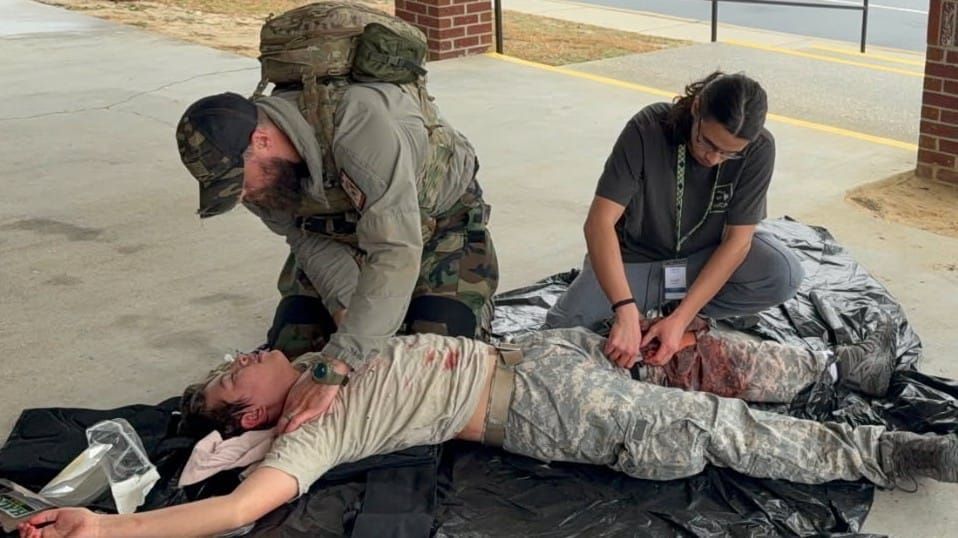
Then you realize that someone has stabbed you in the leg with something red-hot. As you look down the world starts to swim, the floor comes up and hits you, and you realize that your left leg has turned red, and there’s something warm spurting over your leg from under your pants.
What happens now is a matter of training and equipment. You probably saved countless lives just now, but it will be a few minutes, optimistically, until the police arrive, and they’ll have to clear the building before the medics get in. At the rate you’re bleeding you may not be conscious to actually see the officers by the time they get to you. The paramedics will be swamped with casualties, and you’ll be lucky if they even stop the bleeding at all, never mind on time. Then they have to do triage and get transport rolling to the hospital. If you’re really lucky they’ll realize that you are deep in hemorrhagic shock, triage you as immediate, and get you to the hospital where you can undergo a massive blood transfusion. If you're less lucky, you will be so far gone by the time they get to you that they will triage you “expectant.” You will be black tagged, transported last, and you will die on the hard tile floor as they feverishly try to save other casualties.
Of course, there’s an alternate ending to this story. You pull out your tourniquet, tighten it around your leg, and are perfectly conscious, if a bit loopy, interacting with the police when they arrive. You help treat and reassure other casualties until the medics hook you up with some of the good drugs in-route to the hospital. Again, how your story ends depends on training and equipment.
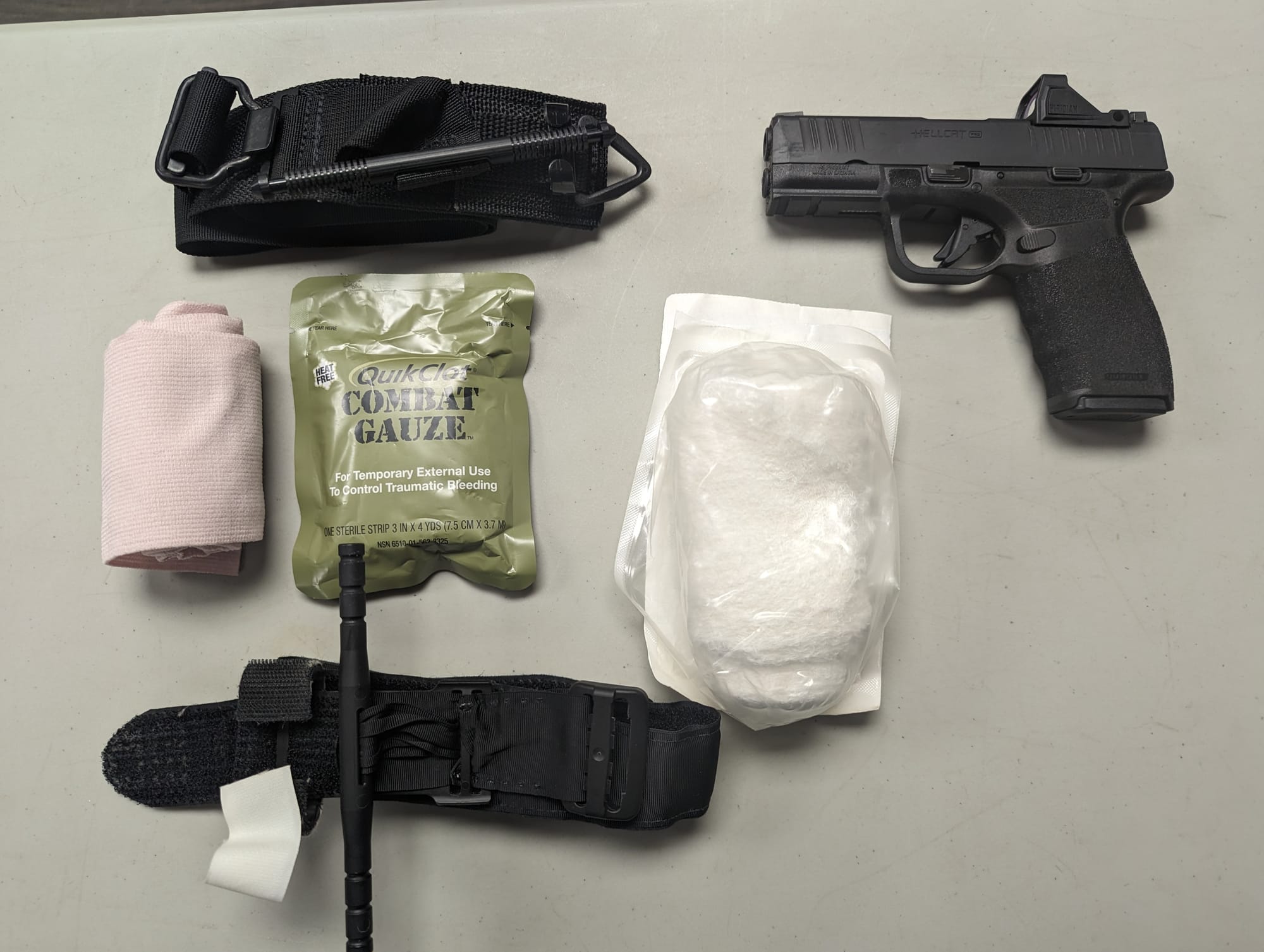
In order to achieve this alternate, and far happier ending, you need two things: knowledge and equipment, and you need them in that order. Let’s say you don’t have a tourniquet, but you know how to make one. While military statistics show very clearly that improvised tourniquets are vastly inferior to the factory variety, you might just slow down the bleed enough to still be conscious when the police arrive. If you have the equipment, but not the training to use it, or you lack both equipment and training, well, back to ending number one!
So get gear and get training. Got it. The problem is this: in order to make a highly competent, basically trained, special operations combat medic, the military spends at least six months, with an extremely high attrition rate, in training. In order to be a tactical paramedic in the law enforcement world, you need to be a paramedic first, then attend tactical training. Unfortunately for the average guy carrying concealed, that training time just isn’t there. Those guys get paid to train, most of us don’t. It’s that simple. The fact is that all of us deal daily with mundane tasks that have serious real-world consequences in our personal lives, and stuff like tactical medical training is an extra. Since we don’t currently live in a warzone where getting shot or blown up is a serious daily risk, trauma medical training is not top of mind for most of us. A lot of times it just doesn’t get done.
Fortunately, there’s some good news on the horizon. When it comes to true, life saving trauma medicine, the individual concealed carrier can get some huge value with very little time investment. Let me explain.
The military has recorded statistics on preventable death in combat trauma for decades now, and for decades the results have been similar. In order, the leading preventable causes are:
1. Exsanguination (bleeding to death)
2. Chest Trauma
3. Airway trauma or complications
4. Everything else
The key here is that bleeding to death is, by a huge margin, the most common cause of death. IT IS ALSO THE EASIEST TO FIX. Before we get too excited about that though, we need a couple caveats; a quick reality check if you will.
1. First, most serious airway or thoracic trauma is beyond repair at any level below full paramedic, or very often, surgeon. There are some exceptions for airway complications where potentially life-threatening issues can be fixed with some very basic training, but otherwise the generality holds.
2. In another piece of bad news, military statistics may be biased towards extremity trauma (the types of bleeds that are easy to fix) by the prevalence of body armor in military conflict. This is opposed to the lack thereof in active shooter and terrorist incidents. Due to lack of armor there may be more death from thoracic trauma in the civil defense context than the military one. Thoracic trauma, again, falls in the realm of paramedics and surgeons, not the prepared CCW guy.
3. Some of the exsanguination that is categorized as “preventable” by military statistics is only preventable by a surgeon in a full operating suite, not in the field.
To summarize the caveats we could say that while SOME combat injuries are easy saves by basically trained personnel, there is also a percentage only amenable to surgical intervention. Unfortunately, statistical reality says there’s not a whole lot in between. The good news is the “some” category is still a very large percentage. In other words, while exact numbers are hard to predict, there is no doubt that just by knowing how to do some basic tasks a very significant percentage of combat deaths, perhaps trauma deaths in general, can be prevented. Those tasks are:
· Apply a tourniquets
· Apply a pressure dressing
· Pack and wrap a wound
· Apply hemostatic dressings
· Do very basic airway interventions
This is what the US military came to realize in the early 2000s at the height or the Iraq and Afghanistan conflicts. In short, there are a few very basic skills, that if drilled hard have very outsized impact on preservation of life. Also, most of the time the guys who apply these skills in real life are not the highly trained combat medics, but the infantry soldiers or special operators themselves. When someone gets shot or blown up the medic is usually not right next to them, but their fellow infantryman is. One special operations group trains their personnel (or at least did at one point) with the following acronym.
Fight!
Uncontrolled hemorrhage
Communicate
Keep killing bad guys!
That’s right, it’s that simple. Stop the red stuff from coming out of the body! After that, just don’t let the bad guys kill you or your buddy. Everything else is usually something you can’t fix anyway, so just keep doing your job and get the casualty to someone who can fix it. If we boil it down to these terms, the problem of trauma management in active shooter or terrorist scenarios just got a lot simpler. Another way to put it:
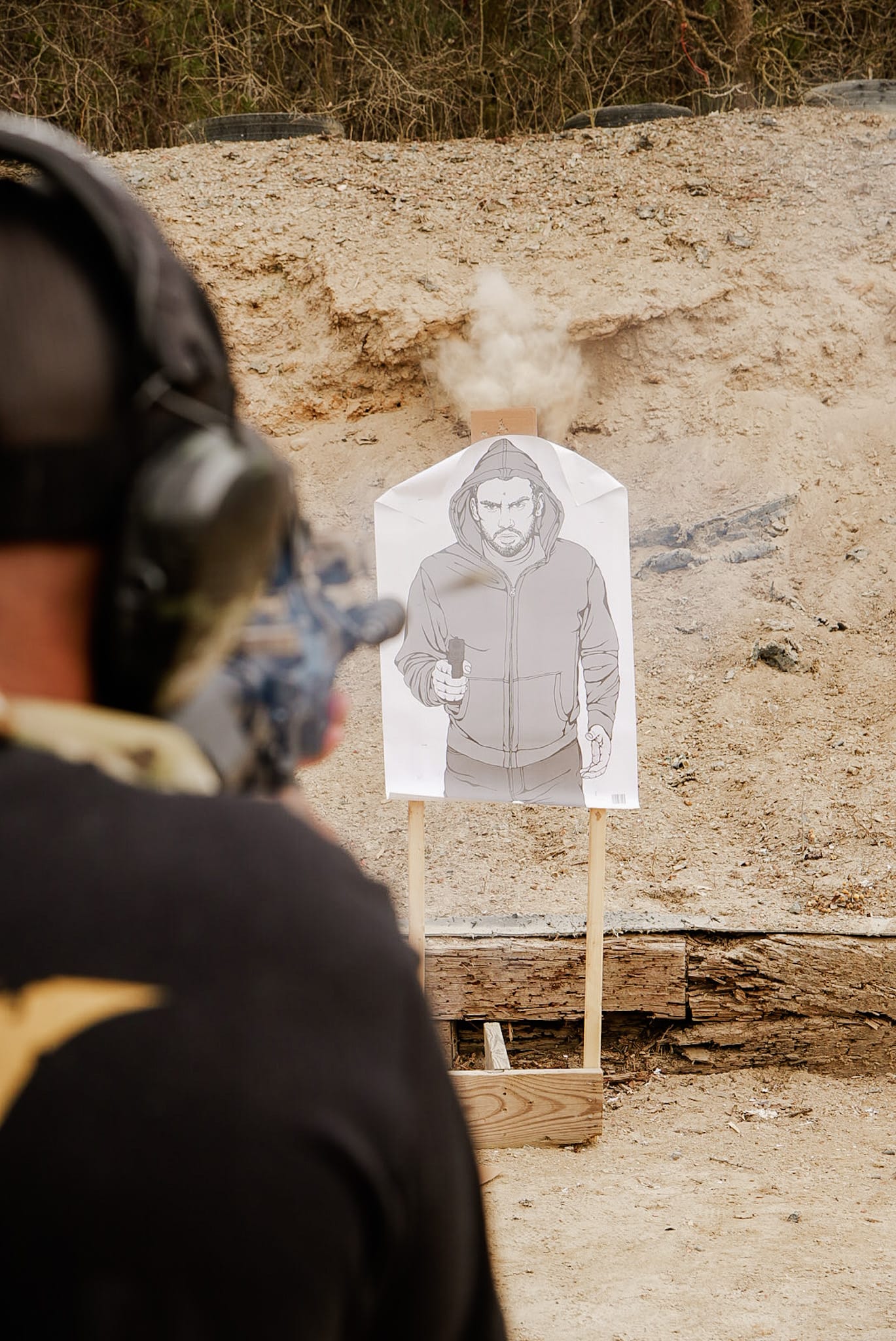
1. Kill the bad guys. Law enforcement likes the saying “stop the killing to stop the dying." In the military it's "superior firepower is the best medicine."
2. Treat casualties: fix the people you can fix.
3. Coordinate Evacuation: get the casualties you can’t fix to someone who can.
Ideally steps two and three would happen concurrently, but let’s not complicate! If these are your priorities, and you are trained and equipped to make them happen, then you are part of the solution; and remember: “your either part of the problem, part of the solution, or just in the way.” Don’t be in the way!
Be armed, be trained, and I’ll see you on the range.