Gear Review: RMJ Jenny Wren Tomahawk
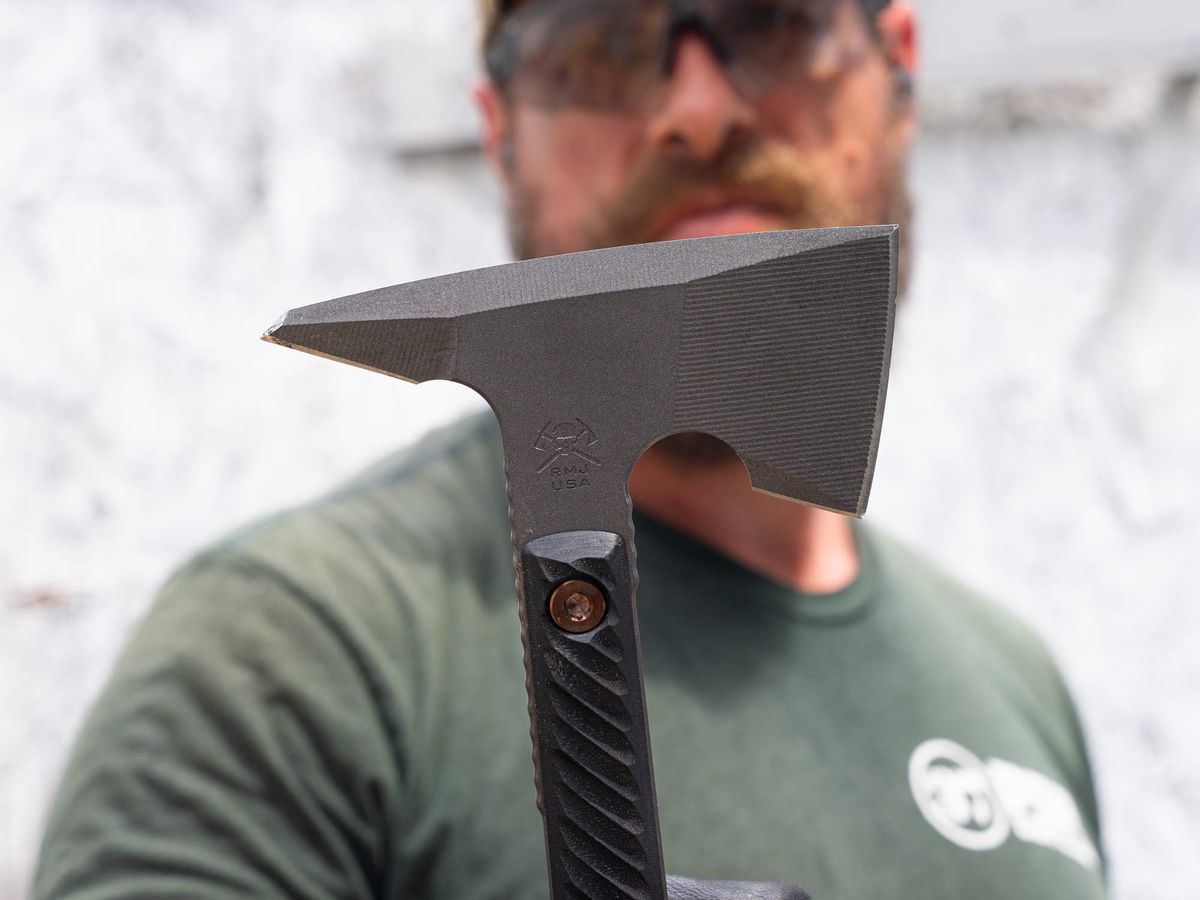
For this one we thought we’d pivot away from think-pieces about training philosophy and the like, and review some gear; a thing we plan on doing some more of in the upcoming months in a sort of on-again-off-again kind of way. I have always had a keen interest in edged weapons and edged weapon combatives, so I thought we’d start with a bang and do a tomahawk review! Also, this isn’t just any ‘hawk, this is the RMJ Jenny Wren, one of the flagship products of Ryan Johnson’s RMJ Tactical, considered by many the premier maker of high end tomahawks, or at least among the top few. I did a significant amount of research prior to this purchase, and after testing I concur that RMJ’s reputation is well earned. Bottom line up front: Only you can decide whether the premium price point is justified, but there’s no argument on whether or not this thing delivers in terms of doing its job.
So why tomahawks? Well, when it comes down to it a hand axe does three things well, albeit to varying degrees depending on design: hand to hand combat, woodcraft, and cutting through structural materials. As a sub-category under structural materials we could say that some axes can be used for glass, chains, lock hasps, wires and cables, prying, or potentially even auto pillars if needed. I tend to think of tomahawks as more of a personal preference item for stuff like this, because there are dedicated tools that probably work better for those individual tasks. This review will stick to structural materials (we will use chip board as a representative) and combative application but will not cover other breaching applications.
Testing the Jenny Wren was pretty straight forward. We used a pork shoulder and a rack of ribs secured to Durablock (the material we use for trapping bullets in our live-fire shoot house) under a heavy work jacket. This tested muscle and bone penetration through heavy clothing using basic combative movements for a tomahawk: hacks, slashes, punches, and hooks . We also tested the back spike with a raking motion that would be used to damage a limb or a neck at grappling distance, and with a modified back-cut similar to what one might do with a bowie knife.
After these tests we sliced a sheet of chip board in half, which I figured is a pretty reasonable assessment against basic wood structural materials, in case, for whatever reason, a wall has to made into a window. We then slammed the tool into a Kevlar helmet with aluminum hardware on it a couple times, both the primary edge and the bottom corner where the beard meets the primary edge, and then repeated a couple cutting tests on the meat to see what the result of edge degradation might be for any combative application.
Speaking of edge degradation, the durablock we were chopping into had all kinds of lead, staples, and bullet jackets inside of it (from being shot and having targets stapled to it). Also bone is very hard, and can actually be something of an abusive medium on chopping tools. So the fact that some edge degradation occurred with testing shouldn’t surprise anyone.
Meat Cutting Tests
Our results were impressive to say the least. We tested the Jenny Wren right out of the box with the factory edge, and that factory edge was vicious, as you can see in the included video. A few highlights:
· A direct chop into the pork should went through the heavy jacket with zero effort and actually cut through the heavy bone of the shoulder joint, completely burying the blade
Chop into the pork shoulder.
· We fastened the top of the ribs on top of the durablock to simulate a clavicle or similar anatomic target on a downward swing. The tomahawk split the bone in half and chopped deep into the back stop.
Direct downward chop to simulate an attack on a clavicle or other bony structure.
· A hooking attack with the beard actually split one of the ribs longitudinally, penetrating all the way through the bone and lodging in the durablock.
Hooking attack with the beard of the tomahawk.
· Punches, holding the ‘hawk in a choked up grip and executed like a boxer’s hook to the ribs either cut through the jacket and knicked the bone of the ribs, or cut through the jacked and the muscle between the ribs and poked into the durablock.
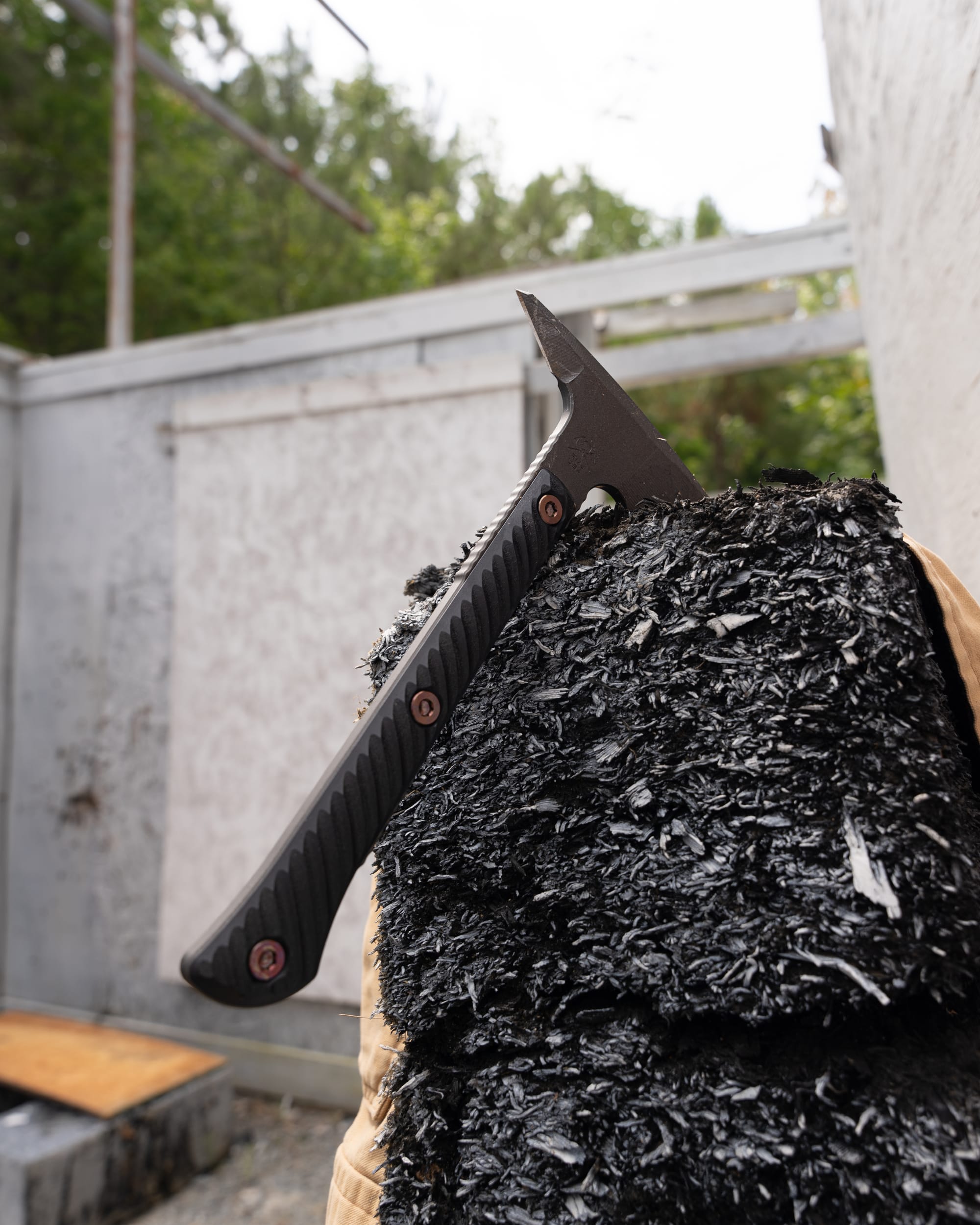
· Attacking with the spike resulted in penetration of the spike, but not much of a cutting action on the way out of the target. Still this motion, somewhat similar to an exit hook thrown by a boxer, but oriented downward, would be sufficient to likely puncture a skull, and probably have sufficient depth for a carotid, or even a subclavian artery.
· Slashing attacks were difficult. Due to the square head design if the distancing was not exactly right, instead of slashing the target, the whole head would simply bury into the muscle mass. This of course, causes even more devastation than a slash, so it’s not a bad thing. When I did finally manage a good slash the edge made about a 3-inch cut in the jacket and made a couple inch deep laceration in the pork shoulder.
· The single attack that proved ineffective was using the bottom edge of the spike to rake a target that the ‘hawk was already in contact with. This would be done potentially to a trapped arm or leg in a grapple. The bottom edge of the spike failed to cut through the jacket, and even against bare meat wrapped in plastic-wrap the raking attack had relatively unimpressive results.
Raking attack on the meat target.
· Once the blade buried in the target the only way to pull it out was really to choke up on the grip and pull back in the direction that it went in. This is probably because of the choil design meant to allow a choked up grip for either punching in close quarters or for fine utility work. Because of this design the sharpened beard doesn’t really do much in the way of allowing the tomahawk to cut its way out of the target.
· It is also worth noting that I punched hard into the target holding the ‘hawk in a fully choked up grip, and while I was wearing gloves, at no point was concerned about my index finger being cut by the beard.
Structural Materials and Edge Damage
A slashing type attack on the meat target and cutting a piece of chip board in half.
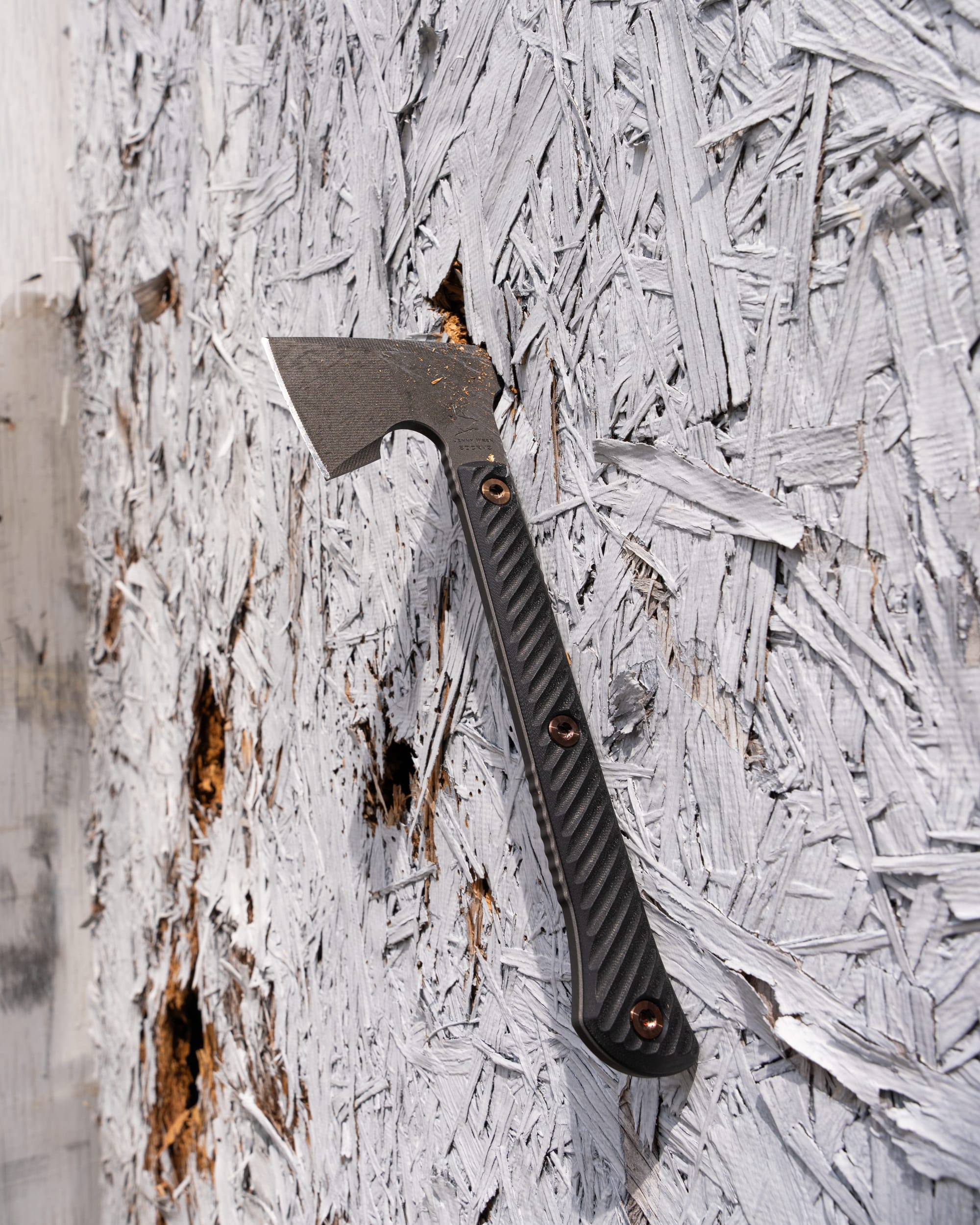
After the meat cutting tests the hawk had some minimal edge deformation from either cutting through bone, or from metal fragments embedded in the backstop. In that condition, it cut through the chip board so easily that in order to avoid wasting energy on having to forcefully dislodge the head every time after it went all the way through the board, I had to modify my technique to more of a slash. After I did that it ripped through the board like a power saw. It was quite impressive.
Smashing it into the Kevlar definitely resulted in some edge degradation. After that it still cut the chip board, but it required more force to do so. It also still penetrated the jacket on a chop and buried in deep, but not with the level of near effortlessness that it had before. After chopping into the helmet and the chip board, slashing the meat target was ineffective: the blade did not penetrate the jacket.
Overall, this test was both educational and impressive. The Jenny Wren really does handle like a purpose designed weapon. It recovers and can be re-directed fast, it is compact but has enough haft length to really be destructive if swung, and the blade edge and geometry allows it to cut straight through heavy bones. After testing it I have 100% confidence that it can either rapidly eat through structural materials or end a fight near instantaneously.
Something like the Jenny Wren is interesting because it functions as a rescue axe or a maybe a woods tool (something I have not yet tested, but that Ryan Johnson says he personally uses it for) while also providing a combative application. Tomahawks are unique in that they can function as a “get off me knife” in a grapple, but, unlike small daggers, they have lethality comparable to a kukri or other short sword at non-grappling ranges. Of course you have to carry it. At 20.5 oz. it’s almost exactly the same weight as an American Tomahawk Company’s Model 1, which is a modernized Lagana Vietnam ‘hawk design. This is light for a tool this size, but still, it’s about twice the weight of a Ka-Bar, and only two and a half ounces lighter than an unloaded Glock 17. Is it worth the cost or the weight? Only you can decide, but one thing is for sure: it works. Has it earned a place in my personal arsenal? Yes.